Intro
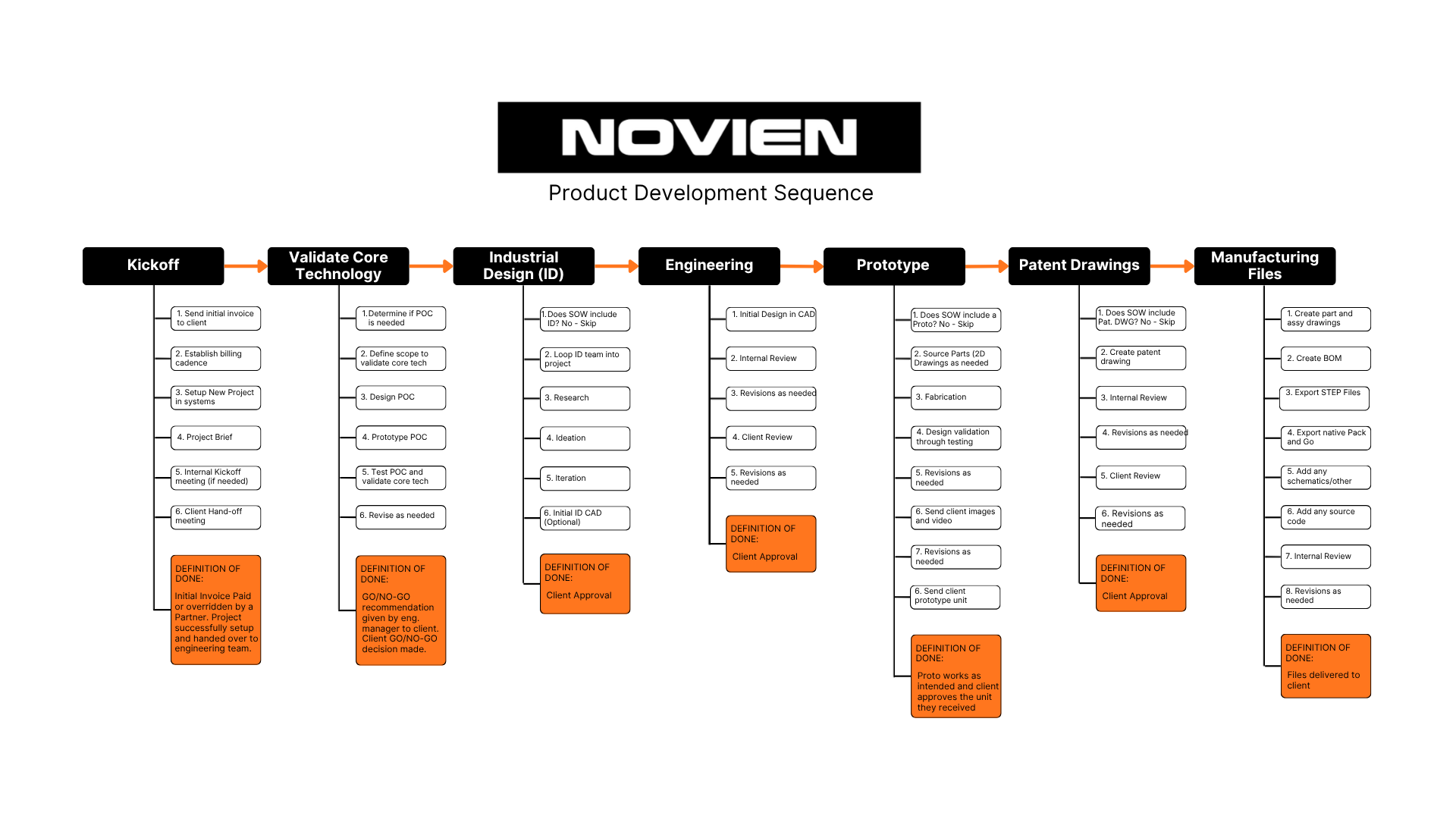
Going through product development in the wrong order inevitably results in wasted time, rework, confusion, and frustration. When building things that last, it is critical to move through the development phases methodically. Taking a product from an initial idea to a mass-manufactured reality requires discipline. Here is the exact process we take our clients through to ensure every project is engineered for the modern industrial landscape.
Kickoff
We begin exactly where you would expect: getting our team completely aligned with the client’s project, goals, and the specific innovation they want to bring to the world. A common mistake in product development is rushing straight into industrial design or deep engineering before isolating what actually makes the product unique. Instead, our first objective is to identify the core technology, invention, or unproven concept that forms the foundation of the client’s vision.
Validate Core Technology
Once we have stripped the product back to its core innovative technology, we must validate it. We design and build a functional proof of concept dedicated solely to testing this specific idea. Until this core mechanism is proven to work in the real world, any further development is a risk. Validating the technology first gives us the hard data and confidence needed to say, “This is going to work,” allowing us to safely move forward into full product development.
Industrial Design
With the technology validated, we shift our focus to how the product will look and feel. We bring in specialized industrial design experts—a distinctly artistic discipline separate from core mechanical engineering—to translate the client’s vision from their mind onto paper. Through a process of ideation and refinement, the industrial design team establishes the product’s aesthetic language, ultimately delivering finalized concept art that dictates the physical form of the product.
Engineering
The engineering phase is where we marry the core technology we validated with the aesthetic vision established by industrial design. The objective is to figure out exactly how to make this product function robustly while remaining manufacturable. Design for Manufacturing (DFM) is baked into this phase from day one.
We evaluate every single part in the assembly to determine how it will be produced—whether through injection molding, CNC machining, compression molding, rotomolding… etc. A part turned on a lathe is designed fundamentally differently than a part shot in an injection mold. We also factor in the intended production volume; designing for a run of hundreds of thousands of units requires a different engineering approach than a run of a few hundred. If a highly complex part requires overly sophisticated and expensive tooling, we may break it down into a sub-assembly of two or three simpler parts that can be made using standard open-and-close molds.
Prototype
While minor prototyping happens concurrently during the engineering phase to test specific functions, this formal stage involves building the complete, fully realized product. This prototype reflects a thoroughly engineered design with DFM fully integrated.
Once fabricated, the prototype is tested, validated, and delivered to the client. If the client is remote, we implement a sign-off step using detailed pictures and videos before shipping the physical unit. This stage is intentionally iterative. The client analyzes the prototype to ensure it aligns perfectly with their expectations. Often, physically interacting with the product sparks new ideas, leading to design revisions, prototype iterations, and further refinements until we achieve final approval.
Patent Drawings
Once the client has signed off on the final prototype and is ready to take the product to market, we move into intellectual property protection. If requested by the client, we generate formalized patent drawings based on the finalized engineering models to support their legal filings.
Manufacturing Files
At the conclusion of the design and engineering process, the client receives a comprehensively organized manufacturing package containing every file necessary to go into production. A finished product design is useless without the proper documentation. This package includes:
- Bill of Materials (BOM): Provided directly on the engineering drawings and as an independent spreadsheet for use by purchasing departments as a working, living document.
- 2D Drawings: Detailed fabrication drawings for all individual parts, sub-assemblies, and final assemblies.
- 3D STEP Files: Universal 3D models for manufacturing reference.
- Native CAD Files: Complete Pack and Go folders of the native CAD (such as SolidWorks). The client fully owns these files, allowing them to bring the project to an internal engineering team later without starting over.
- Production Exports: STL files for 3D printed components and DXF files for flat-cut parts.
Hand-off to Manufacturer
The final step is transitioning from development to actual production. We actively work with clients to stand up their manufacturing processes. For clients looking to manufacture in-house—particularly those focused on American manufacturing, which we are deeply passionate about—we help establish the necessary internal processes and machinery.
If the client prefers to use contract manufacturers, either domestically or overseas, we guide them through that transition. We help leverage the manufacturing file package to submit Requests for Quote (RFQs), evaluate potential vendors, and safely navigate the complexities of ramping up mass production.